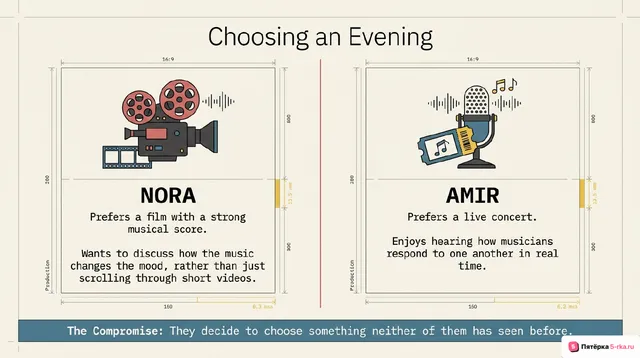


Choosing an evening
Nora: I’d rather watch a film than spend the whole evening scrolling through short videos.
Amir: I’d prefer a live concert. I enjoy hearing how musicians respond to one another.
Nora: What about a film with a strong musical score? We could discuss how the music changes the mood.
Amir: That sounds interesting. Let’s choose something neither of us has seen.
Free time can involve listening, watching, creating and sharing. A person may enjoy a popular song and a symphony for different reasons. Instead of calling an entire genre “boring” or “perfect”, explain what attracts you: a memorable melody, a convincing performance, an unusual sound or a story that raises an interesting question.
review a performance
A melody is a recognisable sequence of notes. Rhythm concerns the organisation of sounds in time. A film score is music written for a film. A soundtrack can include music, speech and other sounds, though the word is also used for an album of music associated with a film. A sound effect, such as a door closing or wind blowing, helps create the film’s environment. These elements may work together but do not have the same function.
Electronic music: tools and choices
Electronic music uses electronic means to generate or shape sound. A synthesiser can create tones rather than simply record an acoustic instrument. A recording can also be changed: its speed, pitch, duration or texture may be adjusted. A short recorded piece of sound is called a sample. Repeating a chosen passage creates a loop. Combining several tracks allows a musician to build layers of sound.
These tools do not make every piece sound the same. One musician may develop a slow, changing soundscape; another may build a strong dance rhythm. Electronic sounds can mix with voices, piano, strings or other acoustic instruments. A laptop is a tool, just as a violin is a tool: the artistic result depends on decisions about form, sound and development.
Using an existing recording also raises questions about authorship and permission. Creating a new arrangement does not automatically make every borrowed recording free to use. For a practice project, students can record their own ordinary sounds and explain how they transformed them. The purpose is to make meaningful choices, not simply add as many effects as possible.