











Цели урока
Узнаем, как по-английски говорить о растительном и животном мире и о природных зонах России.
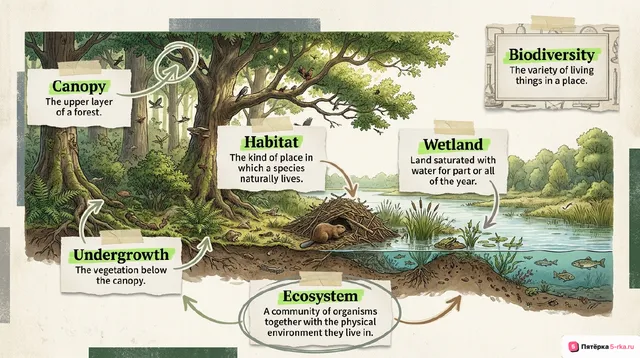
Выучим слова: flora, fauna, species, habitat, endemic, predator, prey, hibernate, migrate, adapt.
Повторим определительные придаточные предложения с who, which, that, whose, where.
Научимся описывать растение или животное и его приспособления к среде.
Вспомним
Стороны света и регионы России: north, south, Siberia, the Far East.
Степени сравнения: the largest, the deepest, colder than.
Read the text: "A country of many worlds"
Travelling from the Arctic coast to the Caucasus, you pass through several natural zones, each with its own flora (plants) and fauna (animals).
In the far north lies the tundra, where the summer is short and the ground stays frozen deep down all year round. Trees can hardly grow here; instead, there are mosses, lichens and dwarf birches that are no taller than a person's knee. Reindeer, which feed on lichen, travel long distances in search of food. The Arctic fox, whose coat turns white in winter, is almost invisible in the snow.
South of the tundra begins the taiga, the largest forest zone on the planet. Its main trees are conifers: pine, spruce, fir and larch. Larch is an unusual conifer, because it loses its needles every autumn. The taiga is the habitat of brown bears, wolves, lynxes, elks, sables and squirrels. Brown bears hibernate in their dens through the winter, and many birds migrate to warmer countries in autumn.