



Цели урока
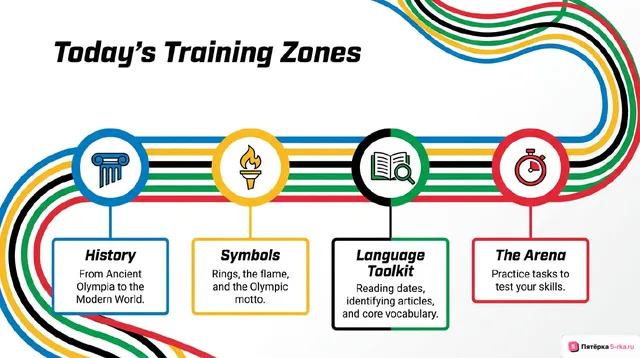
Узнаем по-английски историю Олимпийских игр — от древней Олимпии до наших дней.
Запомним олимпийские символы: кольца, девиз, огонь.
Научимся читать по-английски даты и порядковые числительные.
Повторим артикль the с названиями событий и организаций и нулевой артикль с названиями городов и стран.
Вспомним
На прошлом уроке мы говорили о соревнованиях: win и beat, final, medal, spectators.
Страдательный залог в прошедшем времени: The Games were held in Moscow.
Порядковые числительные: first, second, third, fourth… twentieth, twenty-first.
Текст для чтения: From Olympia to the modern world
The ancient Olympic Games were held in Olympia, in Greece, in honour of Zeus, the king of the Greek gods. The first Games that we know about took place in 776 BC. They were held every four years, and the four-year period between them was called an Olympiad. During the Games a sacred truce was announced, so that athletes and spectators could travel to Olympia safely. Only free Greek men could compete. The programme included running, wrestling, boxing, the pentathlon and chariot racing. A winner received a wreath made of olive leaves, and the victory brought him great fame at home. At the end of the 4th century AD the Games were stopped.
Fifteen centuries later, the French educator Pierre de Coubertin decided to revive the Olympic idea. In 1894 the International Olympic Committee (the IOC) was founded in Paris, and two years later, in 1896, the first modern Olympic Games were held in Athens. The first Winter Olympic Games took place in 1924 in Chamonix, France. Since 1994 the Summer and Winter Games have been held two years apart. In 1960 the first Paralympic Games, for athletes with disabilities, took place in Rome.
Russia has hosted the Olympic Games twice: the Summer Games in Moscow in 1980 and the Winter Games in Sochi in 2014.