











Цели урока
Узнаем, как строилась Москва и какие её здания рассказывают о разных эпохах истории страны.
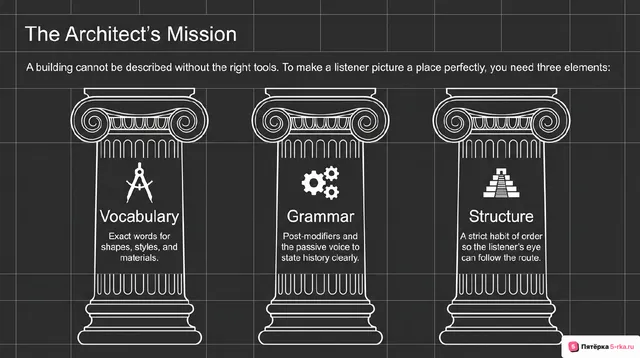
Выучим слова для описания архитектуры: dome, spire, facade, column, mosaic, skyscraper.
Научимся описывать здания и места с помощью определительных придаточных: which, who, whose, where, when.
Вспомним
Пассив в прошедшем времени: The cathedral was built in the sixteenth century.
Порядковые числительные и века: in the fifteenth century, in the 1950s.
Текст для чтения: A Walk Through Eight Centuries
Moscow was first mentioned in the chronicles in 1147, when it was a small wooden town on a hill above the Moskva River. Over the centuries this town grew into the capital of a huge country. Peter the Great moved the capital to St Petersburg, but in 1918 Moscow became the capital again.
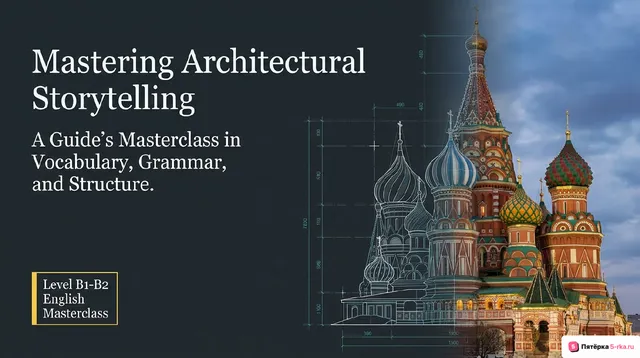
The heart of the city is the Kremlin, a fortress whose red brick walls and towers were built at the end of the fifteenth century with the help of Italian masters. Inside the walls there are cathedrals with golden domes; in the main one, the Cathedral of the Assumption, Russian tsars were crowned. Next to the Kremlin lies Red Square. Its most famous building is St Basil's Cathedral, which was built in 1555–1561 by order of Ivan the Terrible to celebrate the capture of Kazan. Its colourful onion domes make it look like a fairy-tale palace.
The late eighteenth and nineteenth centuries brought Classicism, a style which copied the architecture of ancient Greece and Rome. The Bolshoi Theatre, whose facade is decorated with eight white columns and a bronze chariot of Apollo, is a good example.