

School structures vary across US states, districts and individual pathways. The built-in source card is a simplified model from the supplied learning material, not a rule for every learner.
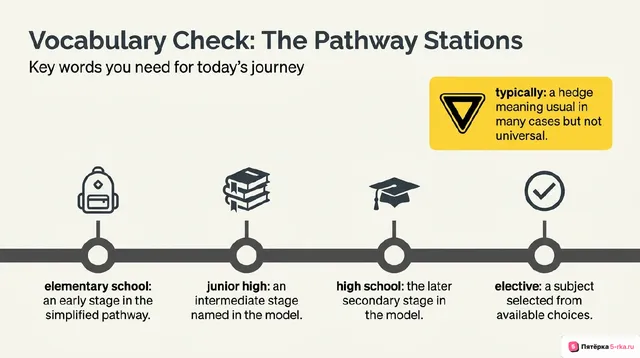
Simplified pathway card: an example learner starts elementary school at about age 5, moves to junior high at about 12, starts high school at about 14 and completes this example pathway at about 17. Stage names and ages may differ elsewhere.
Simplified Russian comparison card from the supplied material: primary school covers Grades 1–4; basic school covers Grades 5–9; one route then continues through Grades 10–11, while another route after Grade 9 leads to vocational education. Starting ages and individual pathways vary.
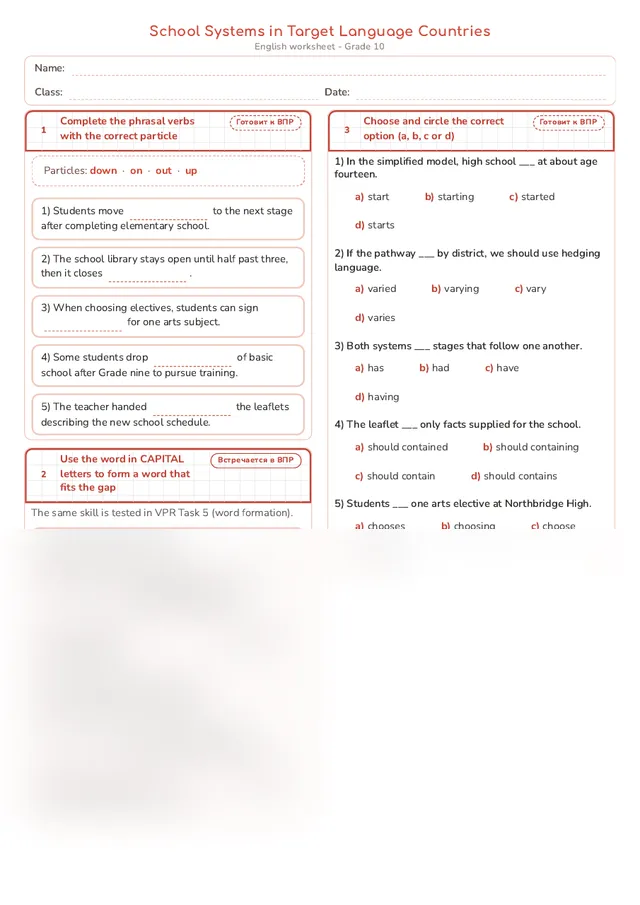
Northbridge High leaflet facts: classes run from 8:30 to 15:10; students choose one arts elective; clubs meet on Tuesday and Thursday; the library stays open until 16:30. This fictional card supplies verified facts for writing practice.
Use hedging language for system descriptions: typically, in this model, may, varies by. Compare stages with whereas, both and unlike without turning one example into a national absolute.
Language map
A diagram or pathway card must be read as a sequence of stages.
The source's age labels belong to one simplified model and require a variation caveat.
A comparison states at least one similarity and one difference while keeping each system's labels separate.
A leaflet should use only the facts supplied for its school.
Comparison language separates similarity, difference and uncertainty.