


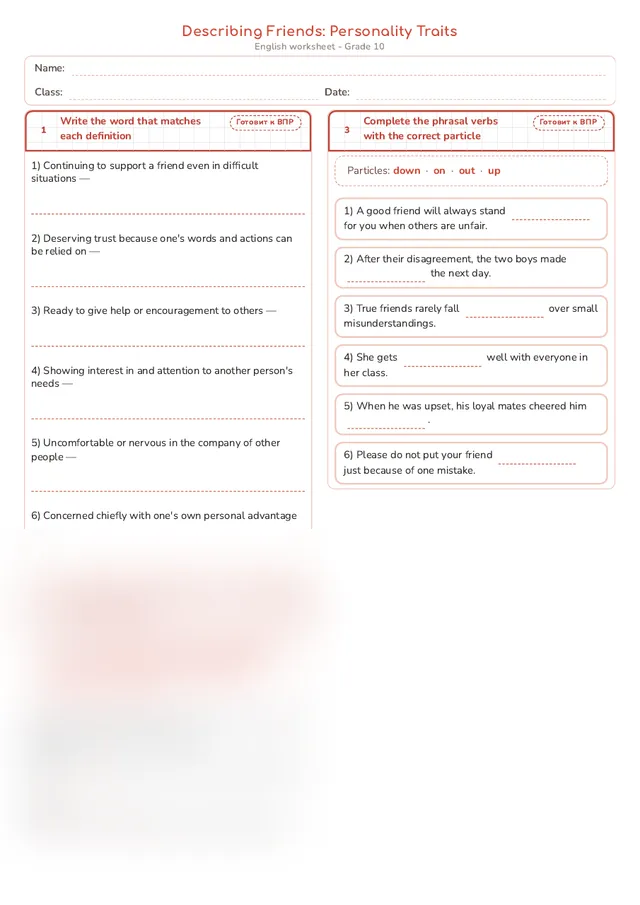
Character adjectives describe behaviour and relationships. A loyal friend stays on your side in difficulty; a trustworthy friend can be relied on; a supportive friend helps or encourages; a caring friend notices another person's needs. Shy describes discomfort in social situations, while selfish describes putting one's own interests first.
Do not confuse trusting and trustworthy. A trusting person readily believes other people; a trustworthy person deserves their trust. Similar pairs also differ: supportive describes a person, while supporting can describe a role; respectful means showing respect, while respected means receiving it.
Built-in dialogue. Nadia: ‘You cancelled our plan again and sent no message.’ Ben: ‘You're right. That was inconsiderate. I'm sorry.’ Nadia: ‘I'm annoyed because I waited for you. Next time, please tell me earlier.’ Ben: ‘I will. Thanks for saying it directly.’ The exchange states the problem, names a feeling, requests a change and acknowledges responsibility.
For a listening round, one reader uses this complete printed dialogue while the listeners cover it; for independent work, the same material is read normally. No missing recording is required.
Useful socialising moves are ‘I agree’, ‘I see your point, but…’, ‘I'm annoyed because…’ and ‘Could you please…?’. Sarcasm says something different from the literal words in order to mock or criticise; recognising it is useful, but a direct respectful sentence is clearer when solving a disagreement.
Language map
Loyal, trustworthy, supportive, caring, shy and selfish describe different qualities and must be chosen by meaning and context.
Trusting and trustworthy, supportive and supporting, respectful and respected are not interchangeable.
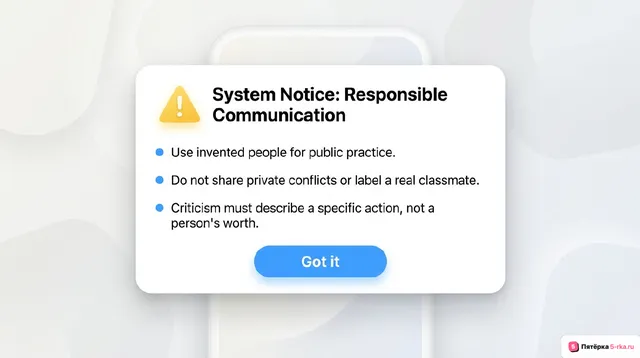
A respectful expression of annoyance names the action and its effect, then makes a clear request without insulting the person.
Reading for specific information means locating the exact line that supports an answer.
A complete embedded script can support either reading or a live listening round.