


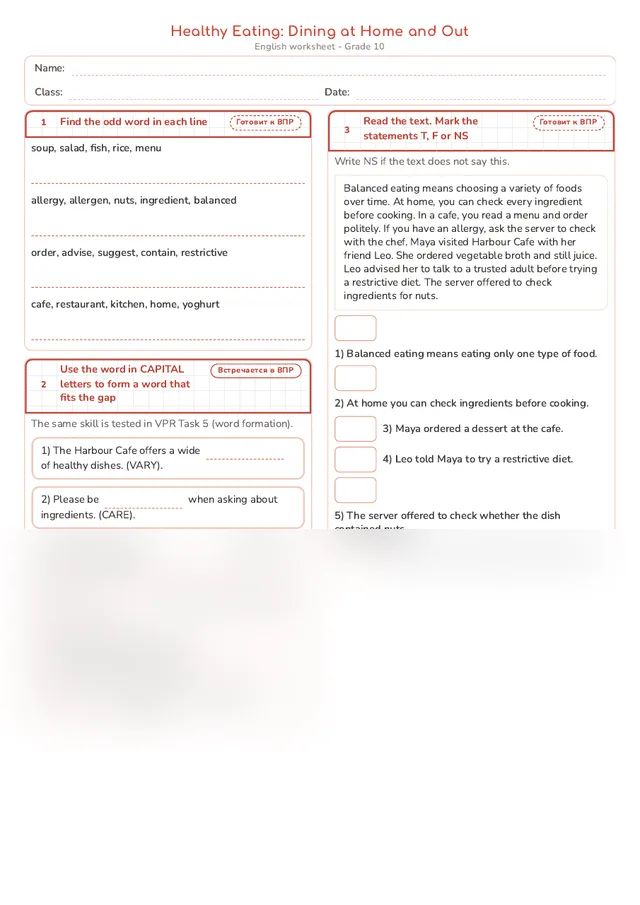
Balanced eating means choosing a variety of foods over time rather than treating one item as a complete diet or as a moral test. Individual needs, allergies, medical conditions, culture and access differ, so an English lesson cannot prescribe a personal diet or a weight-loss plan.
Harbour Cafe menu: vegetable soup; baked fish with rice; bean-and-tomato salad; plain yoghurt with berries; fruit; water. At home a person can describe available ingredients and preparation; in a cafe they also read a menu, order politely and ask staff for verified ingredient information.
Built-in dialogue. Maya: ‘I skipped lunch yesterday and felt unwell. Maybe I should follow a very restrictive diet.’ Leo: ‘I'm not sure that's safe advice for a teenager. It might be a good idea to talk to a trusted adult and a qualified health professional instead.’ Maya: ‘I see your point. For today, could I have the vegetable soup and water, please?’ Server: ‘Of course. Do you need us to check any ingredients or allergens?’ Maya: ‘Yes, please check whether the soup contains nuts.’
For a listening round, one reader uses the complete embedded dialogue while listeners cover the text; the same script remains available for checking. The task therefore needs no external recording.
Advice can be cautious: ‘You could…’ or ‘It might be a good idea to…’. Agreement and disagreement stay respectful: ‘I agree because…’; ‘I see your point, but…’; ‘I'm not sure that is right for everyone.’ A restaurant order uses ‘Could I have…?’; an ingredient question uses ‘Does this contain…?’ or asks staff to check with the kitchen.
Language map
Eating at home and ordering in a cafe require some shared food vocabulary but different communication actions.
Cautious advice and respectful agreement or disagreement are safer and more accurate than a universal food rule.
Could I have…? makes a polite order; Does this contain…? asks about an ingredient.
Restrictive dieting, persistent food or weight concerns and allergy decisions require trusted-adult and qualified-professional support, not a classroom diagnosis.
The complete embedded script supports reading for cohesion and a live listening task for specific information.