

Учимся описывать самочувствие, предлагать помощь и тактично отвечать. Следи не только за словами, но и за интонацией собеседника.
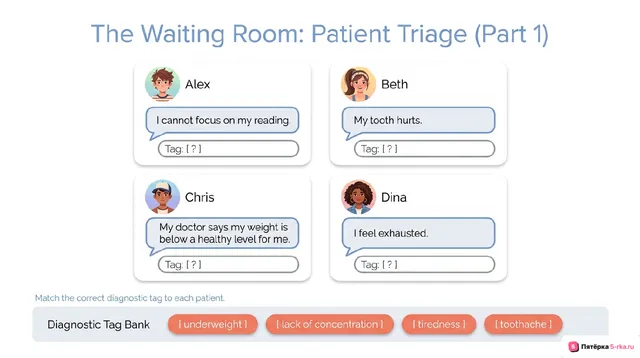
1. Match eight people to these expressions: underweight, lack of concentration, tiredness, toothache, often getting ill, indigestion, dry skin, stomach ache.
Alex: I cannot focus on my reading.
Beth: My tooth hurts.
Chris: My doctor says my weight is below a healthy level for me.
Dina: I feel exhausted.
Ed: I keep catching illnesses.
Faye: My skin feels dry.
Greg: I have discomfort after meals.
Holly: My stomach hurts.
2. Discuss the vocabulary: three well-balanced meals, iron-rich foods, a low-carbohydrate diet, sugary drinks and snacks, vitamin C, oranges, peaches, vegetables, water. Which expression means food containing iron? Which describes a diet with little carbohydrate? Give examples of drinks and snacks.
3. Work in pairs. Choose a situation from task one. Offer advice and respond.
Advice: “Don't you think you ought to…?” “You might feel better if…” “If I were you, I'd…” “You should…” “It might be a good idea to…”
Replies: “Thanks. I'll try it.” “That's not a bad idea.” “Maybe you're right, but…” “It's a good idea, but I'm not sure if it'll work.”
4. Complete the dialogue with: “book an appointment”; “When did it start?”; “I've stopped buying them.”
A: Oh dear! You look uncomfortable.
B: I've got toothache.
A: …
B: It started yesterday.
A: If I were you, I'd… with the dentist.
B: Yes. I also used to buy lots of sugary snacks, but…
A: That's a useful change.
Explain how the replies connect to the previous lines.