

Цели урока
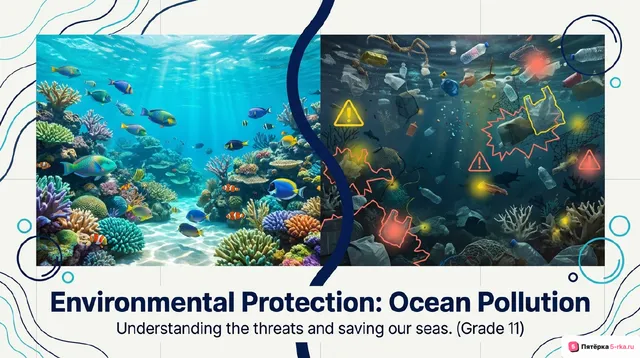
Узнаем, откуда в океане берутся мусор, нефть и химикаты и чем они опасны для морских животных.
Научимся называть по-английски виды загрязнения океана: plastic waste, microplastics, oil spill, sewage.
Повторим слова количества: much, many, a lot of, few, a few, little, a little, the number of, the amount of.
Научимся объяснять, как каждый человек может помочь океану.
Вспомним
Исчисляемые существительные имеют форму множественного числа (a bottle — bottles), неисчисляемые — нет (water, oil, rubbish, sewage).
Загрязнение воды мы уже обсуждали; сегодня речь пойдёт о морях и океанах.
pollute — загрязнять, pollution — загрязнение, polluted — загрязнённый.
Читаем: The journey of a plastic bottle
Imagine a plastic bottle left on a beach. Wind and waves carry it into the sea, and ocean currents can take it thousands of kilometres away. Plastic does not rot like paper or wood. It can stay in the water for hundreds of years, slowly breaking into smaller and smaller pieces. Pieces smaller than five millimetres are called microplastics.
A lot of the rubbish in the ocean comes from the land: from beaches, from rivers that carry waste from towns, and from ships. Currents collect floating rubbish in certain areas. One of the best-known is the Great Pacific Garbage Patch between Hawaii and California, where bits of plastic float over a huge area.